
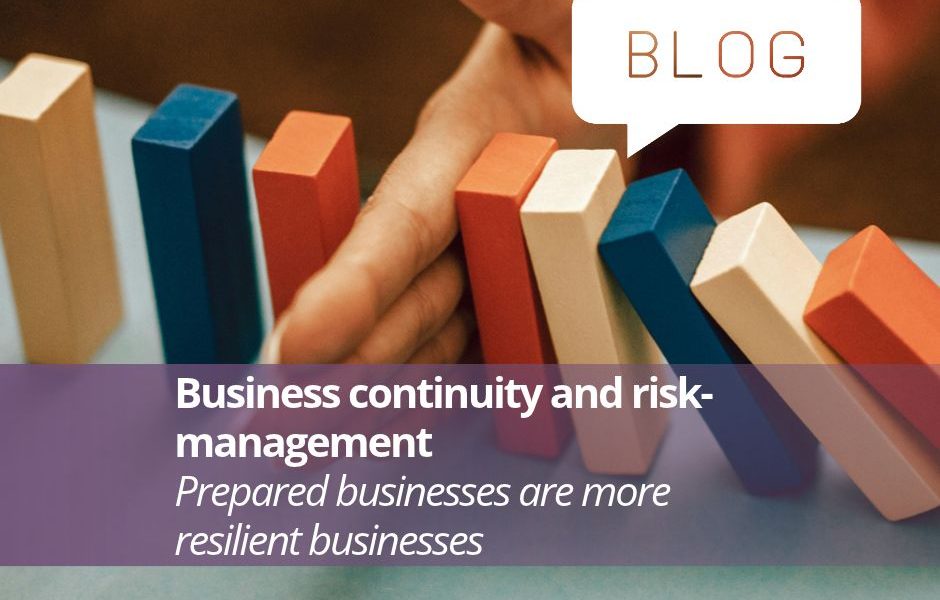
Business continuity and risk-management are vital to stay resilient
- No Comments
By Anthony Goggin, Business Adviser, New Anglia Growth Hub
Prepared businesses are more resilient businesses. This is one of our key messages when we speak with business owners and managers, and nothing is more prevalent now than having regular risk assessments and an action plan that is rehearsed in place. Business Adviser Anthony Goggin shares his expert view and a practical action guide to get you started.
The disruption caused by COVID-19, cyber incidents and severe environmental events such as Dunwich Heath wildfires, has highlighted the importance of business continuity planning. Also, the recent Outlook outage affected businesses and organisations worldwide for a longer period than we have experienced before.
No organisation can anticipate every potential disruption. However, businesses that understand their risks, identify the functions that are critical to continued operation and consider their response in advance are better positioned to adapt when circumstances change. Effective preparation can make the difference between reacting to an incident and managing it.
Read the Risk Assessment Summary and Action Guide – PDF and use the below exercise to identify vulnerabilities, score key risks and prioritise practical actions that strengthen business continuity.
1. Review Planning and Resources
| Area | What to assess |
| Planning | Maintain a medium to long-term business plan; share responsibility for future planning. |
| Early warning | Anticipate shocks and use a system to identify challenges quickly. |
| Contingency | Prepare contingency plans and update risk plans regularly. |
| Finance | Review financial stability and access to funds for unexpected cash-flow pressures. |
| Dependency | Avoid over-reliance on one customer or one supplier. |
| Digital capability | Keep business technology and digital capability up to date. |
2. Score Supplier and Customer Risks
Assess each risk for seriousness and likelihood. Consider supplier failure, rising material costs, disruption or quality problems, inaccurate deliveries, customer loss or non-payment, new competitors, price undercutting, substitute products and distributor loss.
3. Score Plant, Technology and Operational Risks
Consider unavailable premises, equipment failure or theft, data theft, IT failure, lack of access to current technology, raw-material quality, fire or flood, intellectual property infringement and an unplanned increase in demand.
The exercise uses a simple risk scoring methodology – 1–2 Low | 3–4 Medium | 6–9 High.
4. Check the Strength of Business Networks
Review how often the business has discussed its needs with advisers and support contacts during the past twelve months. This may include an accountant, business or legal adviser, bank, mentor, trade association, local authority, government department, Growth Hub, chamber of commerce, fellow business owners, customers and suppliers.
5. Turn the Assessment into action
- List the risks that could interrupt income, delivery or operations.
- Score seriousness and likelihood using the 1–3 scale.
- Prioritise High scores first, especially risks scoring 6–9.
- Assign each priority risk an action, owner and review date.
- Review the assessment whenever the business, market or operating environment changes.
Key takeaway and Action
Focus first on risks with both high seriousness and high likelihood, then record clear mitigation actions and review them regularly.
If you are a running a small to medium sized business that is looking for advice and coaching, get in touch with our team here. Also, sign up to our newsletter to receive our latest news into your inbox.
Lesley van Dijk